
Magneto’s helmet is one of the most recognizable pieces of gear in the Marvel Universe, instantly symbolizing his defiance against Professor X and psychic control. Yet the answer to whether it always blocked telepathy is surprising: no, it did not. The helmet’s telepathic shielding function was a retroactive addition to the character’s lore, emerging decades after his debut and evolving into a core part of his identity through key storylines, cinematic influence, and narrative necessity.
This article traces the helmet’s journey from a purely aesthetic accessory in 1963 to its modern role as a psychic shield. You will learn when the telepathy-blocking function was introduced, how movies cemented the concept, what scientific principles make it work, where its limits lie, and why it became a cultural symbol for mutant resistance.
Helmet Origins: Style Over Substance (1963)
Debut in X-Men #1
Magneto first appeared in X-Men #1 in September 1963, created by Stan Lee and Jack Kirby. The helmet was a striking visual element with no explanation for its purpose. No dialogue or narration suggested it had any special function. It was part of his costume, designed to make him look regal, alien, and threatening. Jack Kirby’s art emphasized its sleek, domed shape, evoking both futuristic technology and ancient authority.
No Telepathic Role Initially
In those early stories, Magneto and Xavier engaged in ideological debates without any reference to mental shielding. The possibility of Xavier using telepathy to stop Magneto was never explored, not because the helmet blocked it, but because the concept had not been invented yet. The power balance between the two was assumed, not enforced by technology.
Aesthetic Symbolism
The helmet’s original meaning was symbolic: a relic of survival, echoing Magneto’s history as a Holocaust survivor. It represented isolation, defiance, and a mind fortified by trauma. Its design, enclosing the head completely, visually reinforced the idea of a man who trusts no one and reveals nothing.
The Retcon: When the Helmet Gained Power (1987 to 1992)

X-Men vs. Avengers #4: Mental Amplifier Reveal
The first major shift came in X-Men vs. Avengers #4 (1987), where it was revealed that Magneto’s helmet was not just defensive but offensive. He used it to project his consciousness into the astral plane, mimicking Xavier’s abilities. This retcon reframed the helmet as a psychotronic device capable of manipulating mental energy. It was not just blocking thoughts; it was generating and amplifying them.
Fatal Attractions: Shielding in Action
The helmet’s telepathic-blocking role became undeniable in X-Men: Fatal Attractions (1992). At Illyana Rasputin’s funeral, Xavier attempts to stop Magneto from leaving by telepathically restraining him but fails. Magneto calmly states that Xavier cannot reach him while he wears the helmet. This moment was the first unambiguous demonstration of the helmet as a psychic shield, resolving a long-standing plot hole and establishing a new canon.
Narrative Necessity
This retcon was not arbitrary. Writers needed a way to preserve Magneto as a credible threat. If Xavier could always stop him with a thought, their ideological conflict would be meaningless. The helmet became the equalizer, ensuring their battles were fought with ideas, willpower, and power rather than psychic domination.
Cinematic Impact: Solidifying the Shield (2000)
X-Men (2000): Function Over Mystery
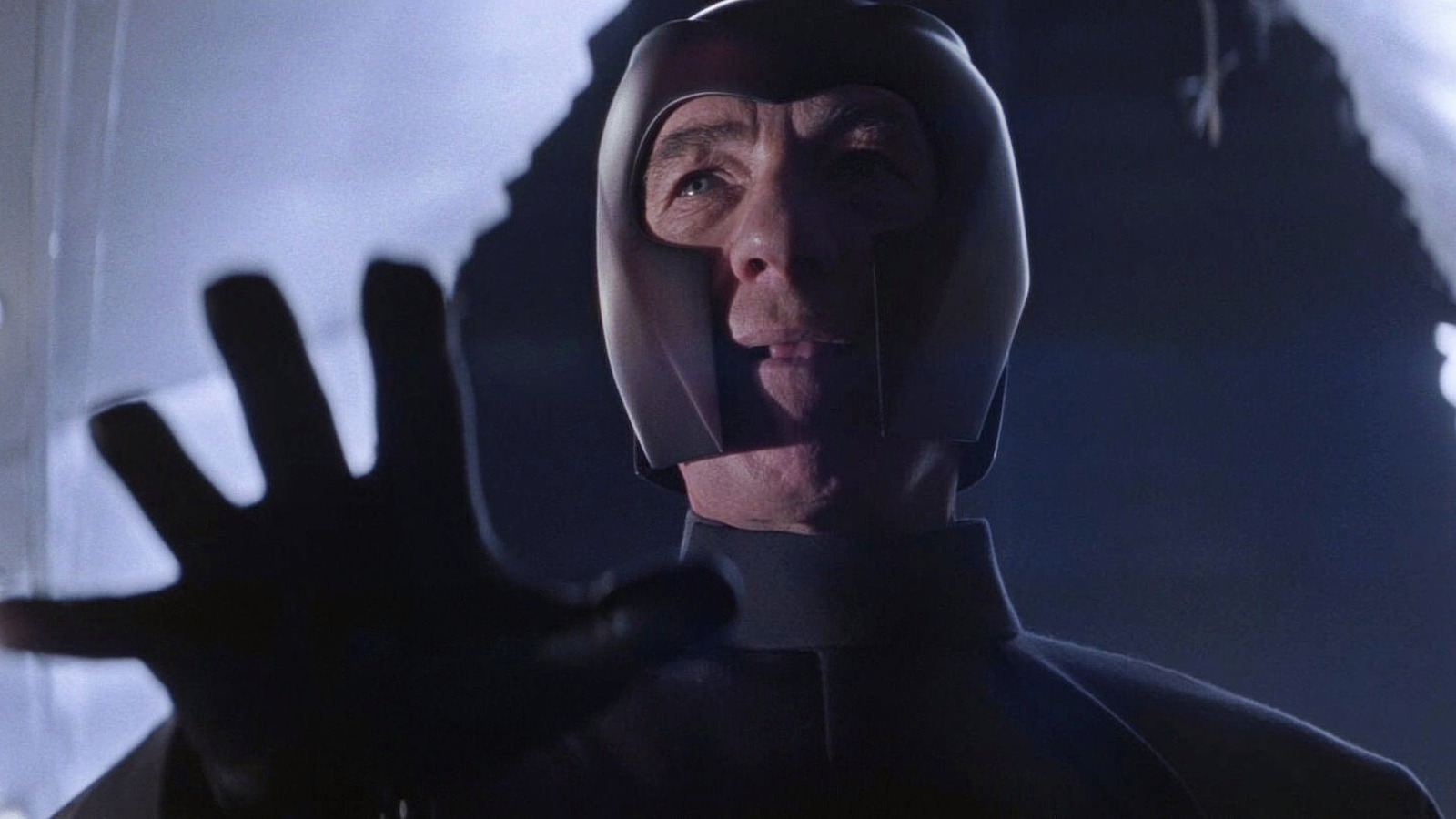
The 2000 X-Men film did not leave the helmet’s purpose ambiguous. From the first scene in the plastic prison, it is clear that Magneto wears the helmet to block Xavier’s telepathy. The film presents it as essential, even showing a backup helmet stored in his base. This straightforward interpretation resonated with audiences and simplified decades of comic lore into a single, powerful concept.
First Class: Origin of the Helmet
X-Men: First Class (2011) added a new layer by giving the helmet an in-universe origin. It was originally built by the Soviets for Sebastian Shaw, designed to block psychic detection. Magneto claims it after killing Shaw, transforming it from a Cold War relic into a symbol of mutant defiance. This version of the story retroactively justified the helmet’s function while deepening its thematic weight.
Apocalypse: Cosmic-Level Defense
In X-Men: Apocalypse, Magneto wears a new helmet forged from Egyptian sand and metal, likely enhanced with vibranium or adamantium. Though visually different, it retains the core function of protecting his mind from external influence, even under Apocalypse’s control. This reinforces that the design may change, but the purpose remains.
How the Helmet Works: Science and Design

Faraday Cage Principle
The helmet operates on a principle similar to a Faraday cage, a conductive enclosure that blocks electromagnetic fields. Since telepathy in the Marvel Universe often functions via psychotronic or electromagnetic signals, the helmet disrupts these waves before they reach Magneto’s brain.
Material Composition
The exact materials vary across storylines, but common descriptions include:
- Magnetic adamantium alloys
- Lead-lined or vibranium-reinforced metal
- Custom-engineered circuitry designed by Magneto himself
Its composition leverages Magneto’s mastery of metallurgy and electromagnetism, making it uniquely effective when worn by him.
Internal Circuitry and Molecular Lattice
The helmet contains complex internal circuitry that scrambles incoming psychic signals. Some versions suggest the metal’s molecular lattice is altered to resonate at frequencies that interfere with telepathic waves. This is not passive shielding; it is active disruption, powered in part by Magneto’s own magnetic field.
Limitations and Vulnerabilities

Removal Equals Instant Vulnerability
The helmet only works when worn. In X-Men vs. Avengers #4, a version of Magneto without the helmet is easily manipulated mentally. This underscores that his resistance is technological, not innate. Unlike Xavier or Jean Grey, Magneto relies on the device.
Cosmic-Level Threats Bypass It
While effective against mutant telepaths, the helmet fails against omnipotent forces:
- Dark Phoenix, whose psychic power is too vast to contain
- White Phoenix of the Crown, who exists beyond space and time
- The Mind Stone, which enhances telepathy to reality-warping levels
Alternative Psychic Vectors
The helmet blocks direct telepathic signals but not all forms of mental influence. Shared dreams, psychic echoes, or indirect manipulation through another mind may still affect Magneto. It is not a 100% mental firewall.
Strategic Uses Beyond Personal Defense

Weaponizing the Helmet
Magneto has used the helmet offensively in notable ways:
- In New X-Men #136, Quentin Quire uses a modified version to neutralize Professor X during a student riot
- In X-Men Red #3, Magneto places the helmet on Tarn the Uncaring, nullifying his mind-based powers before killing him
Mass Production for Mutant Defense
After Cassandra Nova’s psychic assault, Jean Grey urged Tony Stark to mass-produce the helmets in X-Men Red #10. They were distributed to X-Men, Avengers, and Atlanteans as a defense against psychic warfare, proving the helmet’s value extends beyond one man.
Cross-Character Use
Many heroes have worn the helmet to resist telepathy:
- Cyclops wore it against an evil alternate Xavier in Astonishing X-Men #46
- Rogue used it to resist Red Skull’s psychic control in Uncanny Avengers #21
- Wolverine stole it to fight a telepathic foe in Wolverine #3
- Polaris wore a tiara version, symbolizing her complex relationship with Magneto’s legacy
Cultural Symbol: “Magneto Was Right”
Rise of the Slogan
After the destruction of Genosha, the image of Magneto’s empty helmet became a rallying symbol. In New X-Men #135 (2001), students wear “Magneto Was Right” shirts featuring the helmet, rejecting Xavier’s dream of peace in favor of mutant supremacy.
Ideological Legacy
The phrase is not just about power; it is about survival. The helmet represents the belief that mutants cannot rely on human goodwill and that defense and dominance are necessary. Even when Magneto is absent or reformed, the helmet endures as a warning and a promise.
Future Echoes
In Sins of Sinister: Dominion #1 (2023), set 1,000 years in the future, John Ironfire constructs a blood-and-metal helmet to resist a corrupted Xavier. The design is different, but the meaning is unchanged: resistance lives on.
Alternate Realities and Parodies
Earth-1610 (Ultimate Universe)
In the Ultimate Universe, Quicksilver steals the helmet’s blueprints and mass-produces it, leading to tragic consequences, including a father using one to kill his telepathic daughter. This storyline explores the ethical dangers of psychic-blocking technology.
Earth-311 (1602)
In the 1602 universe, Magneto is Enrique, a priest. Xavier gives him the helmet to protect his mind, but Enrique uses it to resist Xavier’s influence and become the Grand Inquisitor, twisting its purpose into one of control.
Spider-Ham and DC Parallels
Even in Spider-Ham, Magneto wears a football helmet, maintaining the symbol in a comedic context. The design has also inspired characters in other universes, like DC’s Dr. Dillard, showing how iconic the image has become.
Frequently Asked Questions About Magneto’s Helmet and Telepathy
When did Magneto’s helmet first appear in comics?
Magneto’s helmet first appeared in X-Men #1, published in September 1963. It was created by Stan Lee and Jack Kirby as a purely aesthetic accessory with no telepathic-blocking function at that time.
What was the first comic to show the helmet blocking telepathy?
X-Men: Fatal Attractions (1992) provided the first clear, plot-critical demonstration of the helmet blocking telepathy. During Illyana Rasputin’s funeral, Professor Xavier attempted to telepathically restrain Magneto but failed because of the helmet.
Can the helmet block cosmic-level telepaths like the Phoenix Force?
No, the helmet has defined limits against cosmic entities. While it can withstand initial attacks from beings like Jean Grey as Phoenix, it cannot protect against omnipotent forces such as the White Phoenix of the Crown or reality-warping power from the Mind Stone.
Has anyone other than Magneto used the helmet?
Yes, several characters have worn versions of the helmet, including Cyclops, Rogue, Wolverine, and Polaris. Each used it to resist psychic threats or nullify mind-based powers in specific storylines.
Why did writers add the telepathy-blocking function to the helmet?
Writers added the function to preserve Magneto as a credible threat. Without it, Professor Xavier could neutralize him instantly with telepathy, eliminating the ideological and physical conflict that defines their rivalry.
Is the helmet’s origin explained in the films?
Yes, X-Men: First Class (2011) reveals the helmet was originally built by the Soviets for Sebastian Shaw. Magneto claims it after killing Shaw, transforming it from a Cold War relic into a symbol of mutant resistance.
Key Takeaways on Magneto’s Helmet and Telepathy

Magneto’s helmet did not always block telepathy; the function was introduced decades after his 1963 debut. The shielding capability emerged through a 1987 retcon that revealed the helmet as a mental amplifier, then solidified in 1992 during Fatal Attractions when Xavier was explicitly blocked. The 2000 X-Men film cemented this role in popular culture, leading Marvel to make it a consistent feature in modern comics.
The helmet operates like a Faraday cage, using specialized alloys and internal circuitry to disrupt psychotronic frequencies. It works against most mutant telepaths but fails against cosmic entities like the Phoenix Force or the Mind Stone. Beyond defense, it has been weaponized, mass-produced, and worn by other heroes, proving its tactical versatility.
Now that you understand the helmet’s evolution, revisit classic storylines like X-Men: Fatal Attractions or watch the original X-Men trilogy to see how this iconic accessory shaped one of Marvel’s greatest rivalries.