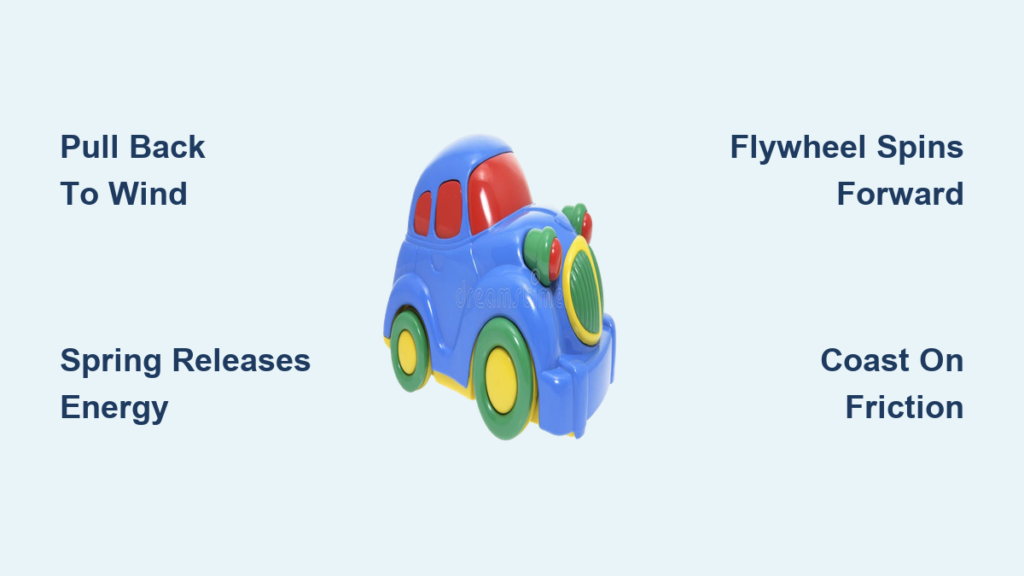
Toy cars zoom across the floor with sudden speed, no batteries required. But how do toy cars work without any power source? The answer lies in clever mechanical engineering that transforms simple human actions into motion using fundamental principles of physics. These self-propelled toys store mechanical energy in springs, flywheels, or rubber bands, then release that energy to drive the wheels forward. This guide explores every mechanism behind toy car motion, from pull-back motors to friction systems, and reveals the science happening in every burst of speed.
Pull-Back Motor: Spring-Powered Motion
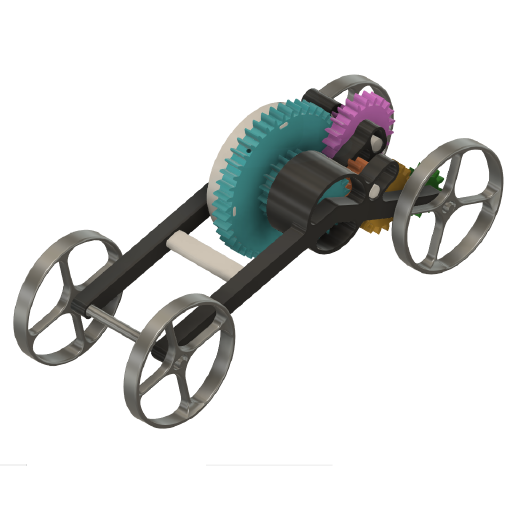
The pull-back motor represents the most recognizable self-driving toy car system. A simple backward tug winds an internal spring, and when released, the car rockets forward with impressive speed.
How the Spring Stores Energy
When you pull the car backward, the rear wheels rotate in reverse, turning the rear axle. This rotation connects through a gear train to a metal torsion spring. As the gears turn, the spring twists tighter, storing elastic potential energy. The farther you pull back, the more the spring winds, and the more energy it stores. Once fully wound, a clicking sound signals the spring has reached its limit, preventing over-winding that could strip gears or damage the mechanism.
How Energy Converts to Motion
Upon release, the gear system switches modes. The wind-up gear disengages while the wind-down gear engages. The spring rapidly unwinds, transferring torque through the gears to the rear wheels. This sudden release creates a burst of forward motion, typically propelling the car 3 to 10 feet on smooth surfaces. The rear wheels must be fixed to the axle for winding to occur, while front wheels rotate freely for steering and reduced resistance.
Key Components Inside Pull-Back Cars
The torsion spring is made of steel coil for durability and stores energy when twisted. The gear train uses large-to-small gear ratios to increase wheel speed, where one turn of the large gear causes multiple turns in smaller gears. Higher ratios deliver more power but result in slower top speed. The axle-wheel connection requires rear wheels to move with the axle, otherwise no winding occurs and no motion results.
Friction Motor: Flywheel-Driven Movement
Friction motor toys move forward when you push them, storing energy in a spinning flywheel rather than a wound spring.
How the Flywheel Stores Energy
Inside the car, a heavy flywheel spins perpendicular to the car’s direction. When you push the car forward, the drive wheels rotate, and gears transfer that motion to the flywheel. The flywheel spins faster, storing rotational kinetic energy. Once released, the flywheel keeps spinning and transfers energy back to the wheels, propelling the car forward for 5 to 15 seconds even after you let go.
Why Surface Friction Matters
The system relies on tire-to-surface friction to transfer energy. On slippery floors like tile or carpet, wheels may spin without turning the flywheel, reducing performance significantly. Some models work bidirectionally, while others use a one-way clutch that engages only when moving forward, preventing backward drag from slowing the flywheel.
Alternative Propulsion Systems
Not all toy cars rely on springs or flywheels. Some use simpler or more creative methods to achieve motion.
Rubber Band and Wind-Up Mechanisms
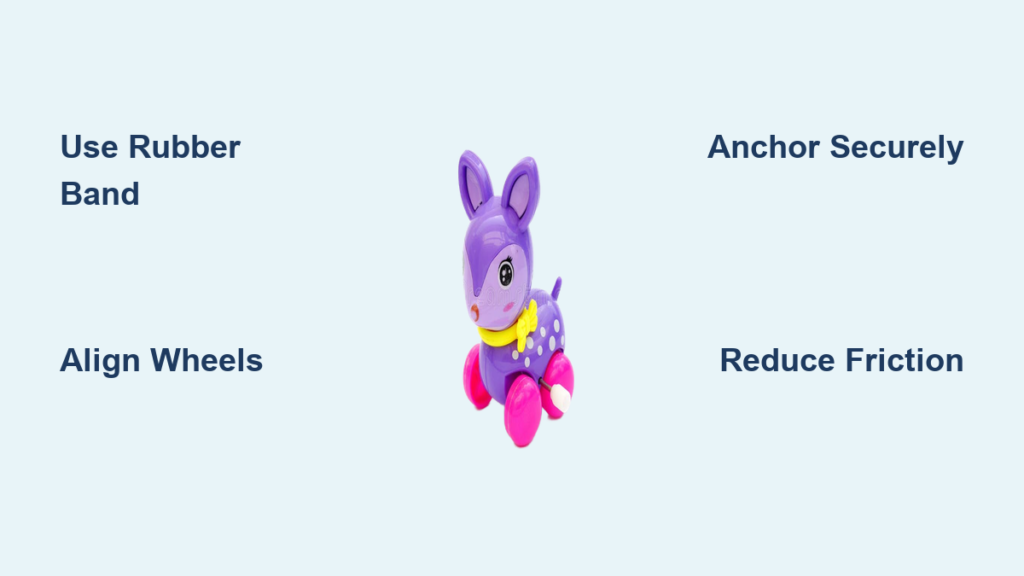
Rubber band motors use a twisted rubber band as the energy source, wound by hand or by rotating the wheels. These are common in DIY science kits and classroom projects. Wind-up mechanisms operate by turning a key or knob on the body, using a spiral mainspring like in old watches. These are found in vintage or high-end toys and offer smoother, longer-lasting motion than pull-back systems.
DIY Pullback Systems
Homemade versions use plastic strips or cardstock wrapped around the axle. Pulling back winds the material like a spring. When released, it unwinds and spins the wheels. Stiffer materials like cardstock cause the vehicle to go farther and faster than flexible plastic strips. Even wrapping a plastic strip around the axle can create a functional pullback mechanism for educational purposes.
The Physics Behind Toy Car Motion

All self-propelled toy cars follow the law of conservation of energy: energy changes form but is never created or destroyed.
Elastic Potential to Kinetic Energy Conversion
When you pull back a toy car, you store elastic potential energy in the wound spring. When released, the spring unwinds and converts this stored energy into kinetic energy, which is the energy of motion. The formula KE equals one-half m v squared shows that kinetic energy increases with mass and the square of velocity, meaning doubling the speed produces four times the kinetic energy.
Newton’s Laws in Action
The unwinding spring creates an unbalanced force that causes acceleration according to Newton’s Second Law. For the same spring strength, a heavier car experiences slower acceleration while a lighter car accelerates faster. Students can observe this directly by attaching coins or washers to toy cars and measuring the resulting changes in speed and distance.
Velocity and Acceleration Patterns
Pullback cars exhibit non-uniform acceleration with rapid acceleration at launch followed by gradual deceleration due to friction. During the first 1.5 meters of motion, the car accelerates in a predictable manner. After this point, acceleration becomes negative, which may cause the car to veer off to the side due to imbalance or resistance.
Educational Uses in STEM Classrooms
Teachers use toy cars to teach scientific inquiry, data collection, and engineering design through hands-on experiments.
Measuring Speed and Acceleration
Students can measure top speed using stopwatches and rulers, introducing concepts like instantaneous versus average speed. Calculating acceleration using the formula a equals 2d divided by t squared helps students understand the relationship between distance, time, and rate of change. Ticker tape timer experiments allow analysis of dot spacing to find peak acceleration and identify when deceleration begins.
Design Challenges and Efficiency Experiments
Students can attempt to transform regular toy cars into pullback cars by creating an open rear axle and securing wheels to the axle. Defining efficiency metrics like distance per full wind or energy efficiency ratio demonstrates how real vehicles measure fuel economy. These projects combine physics principles with engineering problem-solving.
Factors That Affect Speed and Distance
Several elements influence how far and fast a toy car travels.
Spring Material and Gear Ratios
Steel springs offer high energy density and long life, while plastic or paper coils are less efficient but accessible for DIY projects. Stiffer materials store more energy per winding. Gear ratios determine the balance between torque and speed, with higher ratios providing more power at the cost of slower top speed.
Surface Friction and Aerodynamics
Smooth floors like tile or hardwood provide less resistance and longer travel distances, while carpet creates high friction that shortens runs significantly. Streamlined shapes reduce air drag, while heavier cars maintain momentum better but accelerate slower. Wheel tread and material affect grip and rolling resistance.
Historical Highlights and Popular Brands
The Choro-Q, developed by Takara in Japan in 1978, became the most famous pullback car worldwide. Marketed as Penny Racers in the United States, it featured detailed designs, low cost, and reliable pullback motors that made it highly collectible. Matchbox, Hot Wheels, and Corgi used friction motors in many die-cast models from the 1960s to 1980s, combining realism with simple, reliable mechanics.
Comparison of Toy Car Mechanisms

Pullback spring cars use elastic potential stored in a wound coil spring, offering quick bursts with click feedback, ideal for kids and STEM education. Friction motors store kinetic energy in a spinning flywheel, providing smooth, long coasting suitable for play and retro models. Wind-up clockwork mechanisms use spiral mainsprings for precise, longer runs found in vintage and high-end toys. Rubber band motors offer elastic potential through twisted rubber, providing low-cost, DIY-friendly options for science projects. Homemade pullback systems use plastic or cardstock coils for customizable, educational builds.
Frequently Asked Questions About Toy Cars
How does a pull-back toy car work without batteries?
Pull-back toy cars work by storing elastic potential energy in a wound torsion spring. When you pull the car backward, the rear wheels turn the axle, which winds the spring tighter. Upon release, the spring rapidly unwinds and transfers that energy through gears to the wheels, propelling the car forward.
What is the difference between a pull-back motor and a friction motor?
Pull-back motors require you to pull the car backward to wind a spring, then release to launch it forward. Friction motors require you to push the car forward to spin a flywheel, which then keeps spinning and drives the wheels after you release it. Pull-back cars give a quick burst while friction motors coast longer.
Why do some toy cars go farther than others?
Distance depends on spring stiffness, gear ratios, car weight, wheel grip, and surface type. Cars with stiffer springs and lower gear ratios travel faster but shorter distances. Heavier cars maintain momentum better while lighter cars accelerate faster but stop sooner. Smooth surfaces allow longer runs than carpet.
Can toy cars demonstrate Newton’s laws?
Yes, toy cars are excellent demonstrations of Newton’s Second Law. Adding weight to a car reduces its acceleration for the same spring force. The relationship between force, mass, and acceleration can be measured quantitatively in classroom experiments.
How long do toy car mechanisms last?
With regular play, pull-back springs may lose tension over time, and gears can strip if overwound. Low-cost models typically last 1 to 3 years while premium die-cast cars can last 5 years or more. Keeping gears clean and lightly lubricated extends the mechanism’s life.
Are toy cars good for teaching physics?
Toy cars are excellent for teaching physics because they demonstrate potential and kinetic energy, Newton’s laws, friction, gear ratios, and acceleration in a tangible, hands-on way. Schools commonly use them for experiments measuring speed, acceleration, and the effects of mass on motion.
Key Takeaways for Understanding Toy Car Mechanics
Toy cars work by converting stored mechanical energy into motion through springs, flywheels, or rubber bands. Pull-back motors use wound torsion springs that store energy when you pull the car backward, then release it to drive the wheels forward. Friction motors use spinning flywheels that store kinetic energy when you push the car, then coast to propel it forward. These simple mechanisms demonstrate fundamental physics concepts including energy conversion, Newton’s laws, and the effects of friction and mass on motion. Whether you are a child playing with a toy, a student learning physics, or a collector appreciating engineering design, every pull-back car launch represents physics in action.