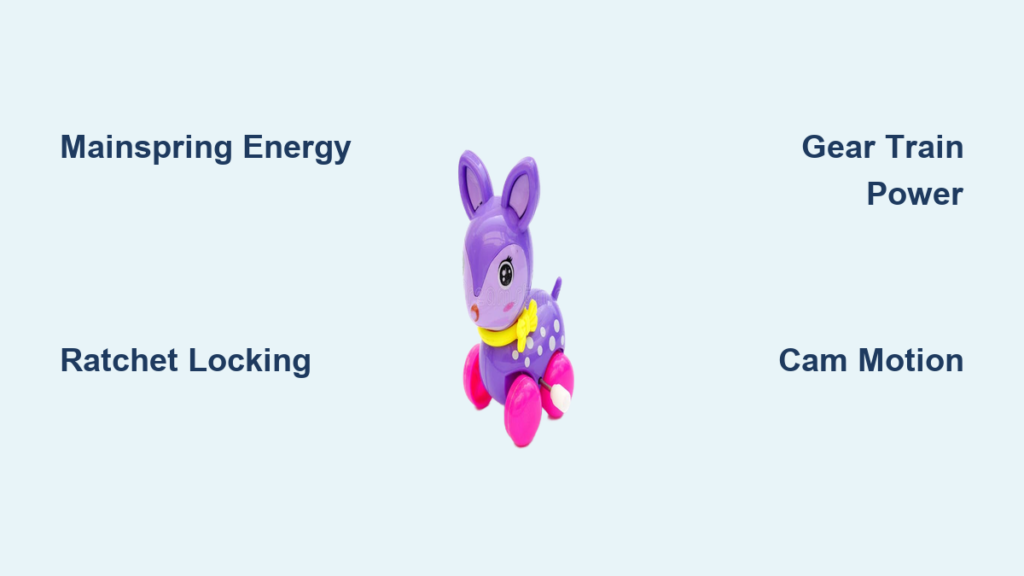
You wind the key, set it down, and suddenly your toy marches, hops, or races across the floor, all without batteries or wires. How does a wind up toy work? The answer lies in a clever clockwork mechanism that stores energy in a coiled spring and releases it in a controlled burst of motion. These toys are miniature marvels of mechanical engineering, transforming your simple twist into walking robots, flapping birds, or rolling cars.
At their core, wind up toys convert potential energy into kinetic motion using just a few precisely engineered parts. When you turn the knob or key, you are tightening a metal spring inside. That stored energy is then gradually released through gears, levers, and rotating cams to create lifelike movements. Unlike battery-powered toys, wind-ups rely entirely on mechanics.
The Mainspring: Your Toy’s Mechanical Battery
The heart of every wind-up toy is the mainspring, a long strip of high-carbon spring steel tightly coiled inside a cylindrical housing. When you turn the winding key, you apply torque that tightens the spring around a central shaft called the arbor. As the spring compresses, it stores potential energy through elastic deformation, just like stretching a rubber band.
This stored energy powers all movement. The tighter the spring, the more energy it holds, and the longer or more forcefully the toy will move. Once released, that energy drives gears, spins axles, and animates limbs until the spring fully unwinds.
What Determines How Long Your Toy Runs
Not all mainsprings perform equally. Several factors determine how much energy they can store and how long the toy will run.
• Spring length and thickness: Longer springs store more energy, extending runtime
• Material stiffness: High-carbon steel resists fatigue and delivers consistent power
• Number of winding turns: More turns mean more stored energy, but over-winding risks breakage
• Coil diameter: Larger coils allow for greater expansion and contraction cycles
A typical wind-up car might run for 1 to 2 minutes after 20 to 30 seconds of winding. In contrast, high-quality clockwork mechanisms in vintage clocks can operate for over 24 hours on a single wind.
The Ratchet System: Keeping Energy Locked Inside

If your wind-up toy lost energy every time you stopped turning the key, it would not work at all. That is where the ratchet and pawl system comes in. This mechanism ensures energy stays locked inside the spring during winding.
The system consists of a ratchet wheel with angled teeth and a spring-loaded pawl, a small metal arm that clicks into each tooth. When you turn the key clockwise, the pawl slides over the sloped side of each tooth. When you stop or reverse direction, the pawl drops into the next valley, blocking backward rotation.
You have probably heard the familiar click-click-click as you wind a toy. That is the pawl snapping into place with each turn. This sound confirms the ratchet is working, each click meaning another bit of energy is safely stored.
⚠️ Common Failure: If the pawl bends or loses tension, the ratchet fails. The toy will not hold a wind, and the spring unwinds immediately.
Regulating Speed: Preventing Runaway Motion
Without control, a fully wound spring would unleash its energy in a fraction of a second, spinning gears wildly before stopping. To avoid this, wind-up toys use speed regulation methods to release energy slowly and steadily.
The most effective control is an escapement, a mechanical brake that meters out power in small, timed bursts. Escapements work by alternately locking and unlocking the gear train, creating a rhythmic tick-tock motion. While common in clocks, simpler toys often skip this component.
Most basic wind-up toys rely on natural resistance instead of a formal escapement. Surface friction, such as placing the toy on carpet, slows the wheels and acts like a brake. Air resistance and inertia help heavy parts resist sudden motion, smoothing out acceleration. Internal friction from gear meshing and axle resistance also helps slow energy release.
Try holding a wind-up car off the ground. The wheels spin fast and stop quickly. Set it down, and friction extends the runtime significantly.
The Gear Train: Transmitting Power Where It Needs to Go
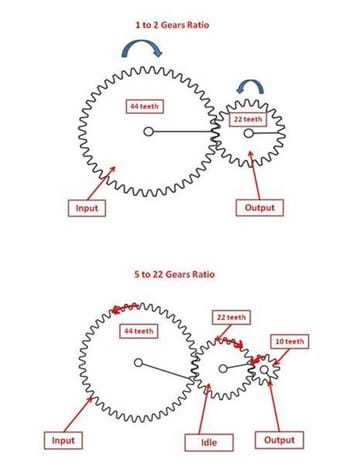
Once energy leaves the mainspring, it travels through a gear train, a series of interlocking gears that transfer rotational force to moving parts. These gears do more than just transmit power. They also adjust speed and torque to match the toy is function.
A small gear driving a large gear produces more torque but less speed, ideal for climbing toys or heavy robots. A large gear driving a small gear produces more speed but less torque, perfect for racing cars or fast-spinning tops.
Multi-stage gear trains combine several ratios to fine-tune performance. For example, a 10 to 1 ratio means the final output spins 10 times for every single rotation of the input gear.
🔧 Design Tip: Poorly aligned gears increase friction and wear, shortening runtime. Proper meshing is critical for optimal performance.
Converting Spin Into Walking and Hopping
Since the mainspring only produces rotational motion, additional mechanisms are needed to create walking, jumping, or waving actions. These systems transform spinning shafts into complex, lifelike movements.
Crank and Connecting Rod Systems
The slider-crank mechanism converts continuous rotation into back-and-forth motion. A rotating crankpin, an off-center knob, connects to a connecting rod. As the crank turns, the rod moves linearly, forward and back.
This system is used in walking robots, flapping wings, and pecking birds. In bipedal robots, cranks on opposite sides are offset by 180 degrees, so when one leg is forward, the other is back, creating a natural stride.
Cam and Follower Motion
A cam is an irregularly shaped wheel, often egg-shaped or lobed, that pushes against a follower, a lever or rod. As the cam rotates, its changing radius lifts and lowers the follower, creating rhythmic tapping, lifting, or oscillating motion.
A Charlie Chaplin toy uses a cam to raise his hat every 30 seconds. A wind-up gymnast uses a cam to alternate between two gears, making the figure flip unpredictably.
Geneva Drive for Step-by-Step Motion
The Geneva drive converts continuous rotation into intermittent, jerky motion. A pin on one wheel engages slots in another, and each full rotation advances the second wheel by one step.
This mechanism is used in hopping toys and clockwork figures with sudden movements. The clockwork smiley man uses a Geneva drive where a knob moves up and down a slot, rocking the legs via a pivot axle to create a hopping motion.
Materials and Design: From Tinplate to Plastic
The outer shell protects internal components and gives the toy its shape. Historically made from tinplate, modern versions use injection-molded plastic for cost and weight savings.
Inside, the gearbox integrates the mainspring and barrel, the gear train, motion converters, and output shafts. Limbs and accessories often attach via snap-on mechanisms, allowing for easy assembly or customization.
In 1977, Japanese company Tomy launched the Rascal Robot, the first mass-produced plastic wind-up toy. It used precision-molded plastic gears, enabling smaller, cheaper designs and sparking a revival in wind-up toys.
Why Wind-Up Toys Remain Popular Today
Wind-up toys offer several distinct advantages over battery-powered alternatives. They require no batteries, reducing waste and long-term cost. They are ideal for off-grid areas or low-resource environments. They promote sustainable play and hands-on learning.
These toys are also widely used in STEM education to demonstrate core physics and engineering concepts, including energy conversion, gear ratios, friction and inertia, mechanical advantage, and motion transformation.
The Spool Racer activity teaches children how twisting a rubber band stores energy and powers motion, just like a real wind-up toy. This hands-on approach makes mechanical principles tangible and engaging.
Frequently Asked Questions About How Wind-Up Toys Work
How does a wind-up toy store energy?
A wind-up toy stores energy in a mainspring, a coiled metal strip inside the toy. When you turn the key, you tighten the spring around an arbor. This coiling stores potential energy through elastic deformation, similar to stretching a rubber band. The energy stays locked in until you release the toy, allowing the spring to unwind gradually.
What makes a wind-up toy stop moving?
A wind-up toy stops when the mainspring fully unwinds, releasing all its stored potential energy. The runtime depends on spring capacity, gear efficiency, friction, and the mechanical load. Surface friction also plays a role, toys running on carpet typically last longer than those on smooth floors.
Can wind-up toys be repaired?
Most modern wind-up toys are not user-serviceable due to their sealed construction. Vintage tin toys, however, are often restored by collectors. Common repairs include lubricating rusty gears, straightening bent pawls, or replacing worn springs. Regular maintenance includes light oil on gears and axles to reduce friction.
Why do some wind-up toys run longer than others?
Runtime varies based on spring size, number of winding turns, gear ratios, and mechanical load. Toys with larger springs and more winding turns store more energy. Heavier toys or those with complex movements consume energy faster. Gear design also matters, some configurations prioritize speed while others prioritize duration.
What is the difference between a wind-up toy and a pull-back toy?
Wind-up toys use a coiled mainspring that releases energy gradually through a gear train. Pull-back toys use a compressed spring that releases most energy in a single burst when released. Wind-ups typically run longer, 10 seconds to 2 minutes, while pull-backs run only 1 to 5 seconds.
Are wind-up toys educational?
Yes, wind-up toys are excellent educational tools. They demonstrate energy conversion from potential to kinetic form. They teach gear ratios and the relationship between speed and torque. They illustrate friction, inertia, and mechanical advantage. Many STEM programs use simple wind-up mechanisms to introduce engineering concepts.
Key Takeaways for Understanding Wind-Up Toy Mechanics

Wind-up toys are elegant demonstrations of mechanical engineering that prove you can create fascinating motion with just a spring, gears, and clever linkages. The mainspring acts as a mechanical battery, storing energy when you wind the key. The ratchet and pawl system keeps that energy locked inside during winding. The gear train controls speed and force, transmitting power where it is needed. Cams, cranks, and linkages convert spinning motion into walking, hopping, or waving actions.
The introduction of plastic gears in 1977 revolutionized toy design, making wind-ups smaller, cheaper, and more accessible. Despite competition from battery-powered toys, wind-ups remain valued for their educational depth, sustainability, and tactile engagement. Next time you wind a toy, take a moment to appreciate the silent symphony of gears and springs at work.