Every child who has ever pretended to be a mechanic or taken apart a toy car deserves a real hands-on challenge. Toy engine repair sets transform that curiosity into interactive play, letting kids unscrew bolts, replace spark plugs, and hear realistic engine sounds as they work. Whether it is a Hot Wheels-style engine bay or a full car maintenance workshop, these toys blend fun with learning while developing fine motor skills and problem-solving abilities.
In this guide, you will discover how toy engines work, how to choose the best set for your child, and how to get the most out of hours of immersive play. You will also learn about common features across brands, what to expect in terms of durability and battery use, and why these sets are more than just plastic parts.
Choose the Right Toy Engine for Your Child
Not all toy engine repair sets are created equal. Some focus on simplicity and affordability, while others offer advanced features like working key fobs, gear shifts, and sound effects. Knowing your priorities helps narrow down the best fit for your family.
Match Age and Skill Level
For kids aged 3 to 4, look for sets with chunky, easy-to-handle parts and minimal small pieces. The Goodyear Car Engine Repair Toy at $49 is ideal here because it is compact, durable, and focused on basic tasks like tire changes and oil checks.
For ages 5 to 7, step up to more complex models like the My Auto Shop Engine Builder with 62 parts or the Hot Wheels Lover’s Set with 58 pieces. These include realistic components such as carburetors, brake discs, and dipsticks, encouraging deeper exploration.
Older kids or collectors may prefer the Theo Klein Service Car Station, a premium build with strong user ratings and nostalgic appeal.
Prioritize Key Features
Consider what kind of play experience you want before purchasing.
For realism, choose models with working lights, sounds, and key fobs like the My Auto Shop Engine Builder.
For STEM learning, pick sets with 60 or more components and step-by-step assembly like the Kids Workshop Set.
For budget buyers, the Goodyear model at $49 delivers core functionality without extra features.
For gift-giving, the Hot Wheels Lover’s Set stands out with 15 repair jobs and a built-in ramp.
Compare Battery and Build Needs
Most sets run on batteries for sound and light features, but mechanical play works even without power. The Hot Wheels Lover’s requires 8 AAA batteries for engine start, horn, and headlight functions. The My Auto Shop needs 3 AA plus a CR2025 watch battery for the key fob. The Goodyear requires no batteries, making it purely manual. High battery usage can be costly over time, so consider investing in rechargeable options.
How Toy Engine Repair Sets Work
These are not random plastic chunks glued together. Real engineering thinking went into how toy engines simulate actual car mechanics. Understanding the design helps maximize play value and troubleshoot issues when they arise.
Interactive Engine Bay Design
Every model features an openable hood or hinged cover revealing a detailed engine compartment. This mimics real vehicles, allowing kids to lift the cowling to access spark plugs, remove the carburetor or oil filter cap, and pull out brake drums or shock struts.
The layout follows real automotive logic, with components grouped where they would appear in an actual engine bay. This gives kids a visual map of how cars work beneath the hood.
Removable Components Explained
Common parts found across all models include spark plugs that are often color-coded for easy identification, oil dipsticks that pull out to check oil levels, headlights that snap in and out with some lighting up, brake discs and wheels that remove to simulate brake service, and battery modules and coolant lines found in advanced sets.
These are not just decorative. They are designed to be handled repeatedly, teaching cause-and-effect relationships like if I remove this bolt, the cover comes off.
Electronic Feedback Systems
Advanced sets use simple electronics to boost immersion. Press the ignition button to hear engine startup. Turn the steering wheel horn to activate sound. Use the key fob to make lights flash and the alarm sound. Shift gears to hear reverse beep or drive mode tones.
These features make play feel authentic, reinforcing the mechanic role-play experience.
Top 5 Toy Engine Repair Sets Compared

Here is a side-by-side breakdown of the most popular models based on features, price, and user feedback.
Hot Wheels Lover’s Engine Repair Set
This set offers the best overall play value with 58 pieces and 15 repair jobs. Kids can perform oil changes, replace headlights, swap brake drums, and store toy cars on the built-in ramp.
Pros include durable plastic, realistic sounds, included tools, and storage space.
Cons include the requirement for 8 AAA batteries and current sold-out status.
Ideal for: Dedicated playrooms or gift-giving when available.
Theo Klein Hot Wheels Service Station
This premium build is a collector is favorite, marketed as a collaboration between Hot Wheels and Theo Klein. The blue unit commands high prices, up to $169.95 for new old stock.
Pros include sturdy construction, excellent durability, and a perfect 5-star rating.
Cons include the expensive price tag, with incomplete versions selling for $45 due to missing parts.
Ideal for: Collectors or families wanting a long-lasting centerpiece.
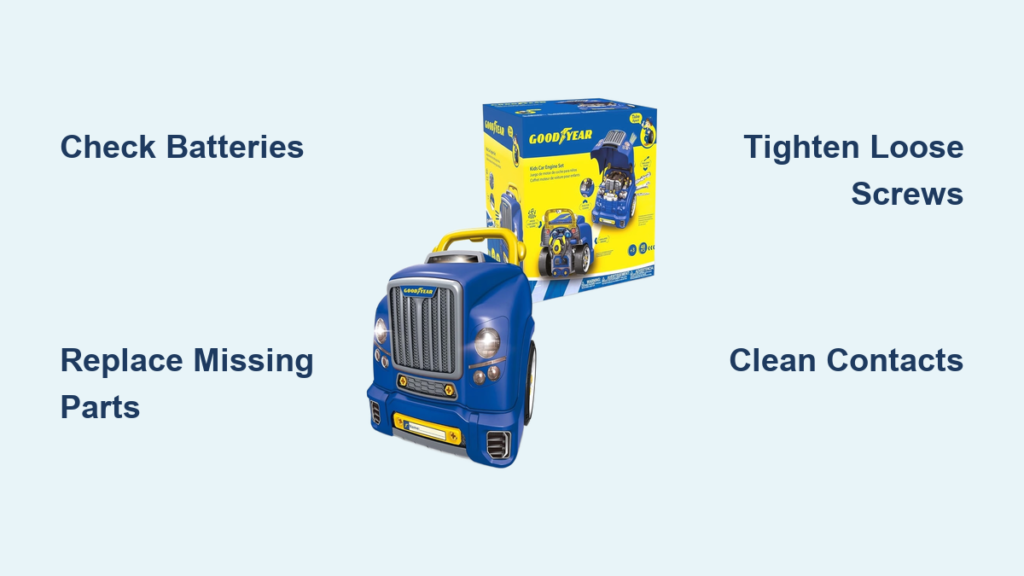
Goodyear Car Engine Repair Toy
Sold exclusively at Costco for $49, this model focuses on core repair tasks without bells and whistles.
Pros include an affordable price, fresh design, and great for siblings with the included smaller companion piece.
Cons include no lights or sounds and the fact that it does not move.
Ideal for: Families wanting tactile play without complexity.
My Auto Shop Engine Builder
This is the most advanced STEM-focused option at $99.95. It features 62 authentic parts including carburetor, shock struts, and gear shift, plus a working key fob with lock, unlock, and alarm functions. Stilts lower to jack up the vehicle, and lights and sounds activate via buttons.
Pros include encouragement of logical sequencing, spatial reasoning, and systematic thinking.
Cons include a higher price point and the requirement for AA and watch batteries.
Ideal for: Homeschool STEM activities or curious tinkerers.
Kids Car Engine Workshop Set
This set emphasizes creativity and group play, though pricing remains unclear. It features DIY stickers and a free custom license plate, supports role-play scenarios like pit stops and race-day prep, and includes an illustrated instruction manual for guided assembly.
Pros include building confidence through mastery and promoting cooperative play.
Cons include unclear pricing and incomplete specifications.
Ideal for: Playdates, classrooms, or personalized gifts.
Why Toy Engine Sets Build More Than Fun
It is easy to see toy engine repair sets as just another plastic plaything. But they do far more than entertain. They are developmental tools that support growth in multiple areas.
Boost Fine Motor Skills
Turning screws, removing bolts, and snapping parts in place require hand-eye coordination and finger strength. Over time, kids gain dexterity that supports writing, tool use, and daily living skills.
Teach Problem-Solving
Each repair job is a puzzle. What goes wrong? Which part needs replacing? What tool fits here? Kids learn to diagnose issues, sequence steps, and test solutions, skills directly transferable to math and science.
Introduce Real Mechanical Concepts
Even at age 3, children absorb real-world vocabulary including oil dipstick, spark plug, brake rotor, and coolant line. This early exposure builds STEM literacy, making future science and engineering topics less intimidating.
Encourage Imaginative and Social Play
Role-playing as a mechanic fosters storytelling. This car broke down on the highway or I need to change the tires before the race. When played with siblings or friends, it promotes communication, cooperation, and conflict resolution.
Troubleshoot Common Issues

Even durable toys can have hiccups. Here is how to fix common problems and keep play going.
No Lights or Sounds
First, check the batteries. Replace with fresh ones, preferably alkaline or rechargeable, and ensure correct polarity when inserting. Clean battery contacts with a cotton swab if corroded.
If still not working, test the sound button or key fob at close range. Reset by removing batteries for 30 seconds. Confirm no broken wires, which is rare but possible after drops.
Missing Parts
It happens, especially with small pieces like bolts or spark plugs. Check storage compartments and play areas thoroughly. Contact the manufacturer, as Fat Brain Toys and Hot Wheels may offer replacements. Use temporary substitutes like colored pegs or LEGO pieces until the original is found.
Loose or Stuck Components
Some parts may become loose from frequent handling. For loose screws, tighten gently but do not over-torque. For stuck covers, apply slight pressure while wiggling and avoid forcing. For sticky stilts or levers, wipe joints with a dry cloth and ensure no debris is trapped.
Never use oil or lubricants because they can damage plastic.
Maximize Long-Term Play Value
To keep the excitement alive, go beyond the box with these strategies.
Rotate and Challenge
Instead of free play every time, introduce challenges. Fix the engine in under 5 minutes. Replace the spark plugs blindfolded with help. Pretend this is a race car and do a pit stop in 60 seconds.
Timed tasks add excitement and build focus.
Combine with Other Toys
Integrate with existing collections. Park Hot Wheels cars on the ramp. Use LEGO tools alongside included wrenches. Add a toy toolbench nearby for expanded garage play.
This creates a full pretend-play ecosystem.
Teach Real-World Connections
Talk about real cars. This spark plug makes the engine go vroom. When Dad checks the oil, he uses a dipstick, just like this one. Brakes stop the car, and here is how they work.
Making real-life links deepens learning.
Final Tips for Parents and Gift-Givers
Choosing and using a toy engine repair set wisely ensures lasting value for your investment.
Storage Matters
Keep it organized using the built-in compartment or a small bin. Label parts if losing them is a concern. Store batteries separately when not in use.
A tidy setup encourages repeat play.
Supervise Early Use
For ages 3 to 4, sit with your child the first few times. Show how to remove and replace parts safely. Name components as you go. Praise effort, not just completion.
This builds confidence and prevents frustration.
Look for Warranties
Some models offer strong support. The Hot Wheels Lover’s Set has a Lifetime Guarantee of Satisfaction. The Kids Workshop Set offers a 1-Year Free Warranty.
Register the product if possible, especially for higher-end models.
Frequently Asked Questions About Toy Engine Repair Sets
What age is appropriate for toy engine repair sets?
Most toy engine repair sets are designed for children aged 3 and up. For younger children ages 3 to 4, choose sets with chunky parts and minimal small pieces. For ages 5 to 7, more complex models with 50 to 60 plus components work well.
Do toy engine repair sets require batteries?
Some sets require batteries for lights and sounds while others are purely mechanical. The Hot Wheels Lover’s Set requires 8 AAA batteries. The My Auto Shop Engine Builder needs 3 AA plus a CR2025 watch battery. The Goodyear model requires no batteries at all.
Are these toys educational?
Yes, these sets offer significant educational value. They develop fine motor skills, teach problem-solving, introduce real mechanical concepts like spark plugs and oil dipsticks, and encourage imaginative and social play through role-playing as a mechanic.
How do I replace missing parts?
Check all storage areas and play spaces thoroughly. Contact the manufacturer, as companies like Fat Brain Toys and Hot Wheels may offer replacement parts. Temporary substitutes like colored pegs or LEGO pieces can work until the original parts are found.
Which toy engine set is best for STEM learning?
The My Auto Shop Engine Builder by Fat Brain Toys offers the most advanced STEM features with 62 authentic parts, a working key fob, gear shift, and interactive lights and sounds. It encourages logical sequencing, spatial reasoning, and systematic thinking.
Key Takeaways for Choosing a Toy Engine Set
There is no single best toy engine repair set. The right one depends on your child is age, interests, and your budget.
Want maximum features? Go for My Auto Shop Engine Builder at $99.95.
Need affordable basics? Try the Goodyear model at $49.
Buying a long-term gift? Consider the Theo Klein or Hot Wheels Lover’s Set.
Encouraging group play or creativity? The Kids Workshop Set wins.
All share one thing: they turn playtime into learning time.
These are not just toys. They are gateways to curiosity where every bolt turned is a step toward understanding how things work. Whether it lights up, makes noise, or stays delightfully simple, a toy engine repair set gives kids the tools to imagine, build, and fix, skills that last a lifetime.